All inclusive service
No hidden fees

Your privacy is important, Prescription Doctor are committed to keeping your details completely confidential.
This is why we also take steps to conceal your prescription products under two layers of packaging.
We have a commitment to delivering a discreet service and understand your need for privacy. We ship all orders via a trackable courier using discreet, plain packaging.
Once your order is dispatched you will receive a tracking number via sms and email.
We deliver medications between Monday and Saturday. You can upgrade to Saturday delivery on Friday.
You should receive a tracking number with your order which you can use this number to track your parcel online. This should give you a clear indication of where your parcel is. If you haven’t received your parcel in the time frame given by our couriers, contact your local depot to find out where it is. You can also contact our support team who will do this for you.
On checkout you will be asked to leave your mobile number so our courier can text you about the delivery. This is also useful if the courier has problems finding your address. We will not use your mobile number for anything else.
You can pay for your order using credit, debit card or via bank transfer.
If you don’t have a credit or debit card you can pay via bank transfer. We will give you a unique reference number at checkout along with details of how to make the transfer. Once the money has cleared in our account, we will process your order.
We are a completely secure site and take many measures to ensure your details are kept safe. We understand that you have a right to extreme privacy when purchasing sensitive health medications. All information that you provide to us is stored on our secure servers. Any payment transactions will be encrypted using SSL technology.
You can pay for your order using credit, debit card and bank transfer.
Card Payment: Please notify us that you wish to cancel your order. Your refund will show available In 1 - 3 days.
Bank Transfer: A member of our team will contact you requesting for your bank details. These details are only used to transfer the funds back into your account.
Acnecide is a topical treatment for mild to moderate acne, and one of the most widely used over-the-counter acne products in the UK. Its active ingredient, benzoyl peroxide, is an organic compound that's been a mainstay of acne treatment for decades. It works on the spots you already have while helping to stop new ones from forming.
This medication is intended for mild to moderate acne. If your acne is severe, with deep cysts or widespread inflammation, a pharmacist or doctor may recommend a stronger prescription treatment instead. It's classified as a pharmacy (P) medicine. That means you don't need a prescription, but it's supplied under the supervision of a pharmacist who can check it's suitable for you.
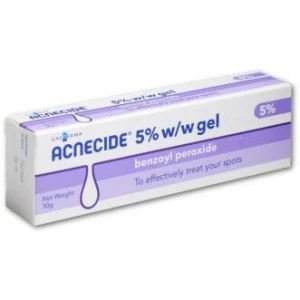
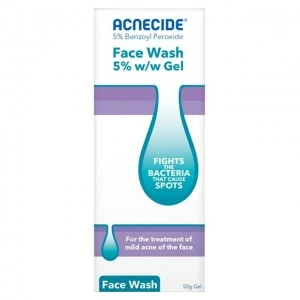
Acnecide comes in two formats, a leave-on gel and a rinse-off wash. Both contain the same 5% benzoyl peroxide but are used differently; the right choice depends on your skin, the severity of your acne, and your personal preference.
Acnecide Gel is a leave-on treatment applied as a thin layer to the affected area once or twice a day. It's a white-to-off-white gel that stays on the skin, so the benzoyl peroxide keeps working continuously between applications. This makes it well-suited to targeting specific areas of acne and to treating more persistent spots. The medication comes in 15g, 30g, and 60g tubes.
Acnecide Wash (sometimes called a face wash) is a rinse-off treatment. You apply it to wet skin, leave it on for one to two minutes, then rinse it away. It contains the same 5% benzoyl peroxide as the gel, combined with special technology that helps absorb excess oil while releasing glycerin to soothe and hydrate the skin.
Because it's washed off rather than left on, it tends to be gentler and less drying, which can make it a good option for sensitive skin or for treating larger areas like the chest and back. Acnecide Wash comes in 50g and 100g tubes.
Acne develops when dead skin cells and excess oil (sebum) block hair follicles. Bacteria called Cutibacterium acnes feed on this trapped oil and multiply, triggering the inflammation that leads to spots.
Benzoyl peroxide, the active ingredient in both Acnecide products, works in a few ways. It releases oxygen into the pore, which kills the bacteria that contribute to acne. It also has a keratolytic effect, meaning it helps unblock pores and clear away dead skin cells, which reduces blackheads and whiteheads.
The gel and the wash work in the same fundamental way; the difference is how long the benzoyl peroxide stays in contact with your skin. The gel is left on to provide continuous action, while the wash delivers a shorter, gentler dose that is then rinsed away. This may make Acnecide wash a more suitable option for people who prefer a rinse-off format, or for larger areas of skin.
It usually takes at least 6 weeks of using Acnecide for your acne to improve, so it is important to persevere with using it as prescribed. Some improvement may be visible sooner, but give it time to work properly. There is no specific difference in how long it takes to work for the leave-on gel versus the wash.
After using Acnecide for one month, it's a good idea to check in with your doctor or pharmacist to review how your skin is responding. If you have still not seen any improvement after 2 months of use, you should talk to your doctor. You should also seek advice sooner if your acne worsens or if irritation becomes severe or persistent.
Benzoyl peroxide is one of the most well-established acne treatments available, and there's strong clinical evidence behind it. For example, a placebo-controlled trial involving over 600 patients found that 5% benzoyl peroxide gel reduced inflammatory lesions by 75% over a 12-week period, compared with 41.7% in the placebo group.
A longer-term study of over 450 patients concluded that benzoyl peroxide reduced total lesion counts by around 65% at 12 weeks, rising to around 80% by 52 weeks. There was also no loss of effectiveness over time and no evidence of bacterial resistance.
Finally, an NHS-funded trial of almost 650 patients found that benzoyl peroxide was a cost-effective treatment for mild to moderate facial acne, performing comparably to antibiotic-based regimens.
Both the gel and the wash contain the same 5% benzoyl peroxide, so both deliver this active ingredient, though the leave-on gel keeps it in contact with the skin for longer. There is no direct evidence comparing the two, so it mostly comes down to preference. Everyone responds differently, and Acnecide works best with consistent daily use.
Both Acnecide Gel and Acnecide Wash are for external use only and may be used once or twice daily. The key difference is that the gel is left on the skin, while the wash is rinsed off after one to two minutes. Whichever you use, it helps to start slowly. Benzoyl peroxide can cause irritation at first, so beginning with once-daily use lets your skin adjust before building up to twice daily if needed.
For both products, avoid using them in strong sunlight. If sun exposure is unavoidable, use a suitable sunscreen and apply Acnecide in the evening.
Benzoyl peroxide can also bleach hair and coloured fabrics, including clothing, towels, and bed linen, so take care to avoid contact with these.
Don't worry if you forget to use Acnecide at the right time. When you remember, simply start using it again as before. Don't apply extra to make up for a missed application.
If you accidentally use too much, your skin may become irritated. Wash off as much as you can, and once the irritation has settled, resume use as directed. Using more than directed won't clear your acne any faster. In the rare event that Acnecide is accidentally swallowed, seek medical advice.
Like all medicines, Acnecide can cause side effects, though not everyone gets them. Most are mild skin reactions that tend to appear in the first few weeks and settle as your skin adjusts. They're usually reversible if you reduce how often you use the product or stop temporarily.
This section covers the known side effects, signs of a more serious reaction, and the main precautions to take.
When deciding whether a treatment is suitable for you, it’s important to have a clear understanding of the potential adverse reactions, even if there is a chance you won't experience any. The table below outlines possible Acnecide side effects to help you make a more informed decision.
Very Common (may affect more than 1 in 10 people) | Common (may affect up to 1 in 10 people) | Uncommon (may affect up to 1 in 100 people) |
|---|---|---|
|
|
|
Please note that the above is not an exhaustive list of possible Acnecide side effects. More information can be found within the Patient Information Leaflet that comes with the medication.
If you experience any side effects, you can report them through the Yellow Card Scheme. This helps the MHRA monitor the safety of medicines and is open to patients and healthcare professionals alike.
If your skin becomes severely irritated, or you experience severe redness, itching, or peeling, or any swelling of the face, stop using Acnecide immediately and speak to your doctor or pharmacist.
Tell your doctor immediately if you develop signs of a severe allergic reaction:
A serious allergic reaction is a medical emergency – call 999 or go to A&E if symptoms are severe or worsening rapidly.
Acnecide is suitable for most people, but there are some important precautions to be aware of before you start, from how to protect sensitive areas of skin to which other products to avoid using at the same time.
Read the patient information leaflet for the product you're using before beginning treatment.
Tell your doctor or pharmacist if you're taking, have recently taken, or might take any other medicines.
Don't use products with peeling, irritant, or drying effects at the same time as Acnecide, and don't use Acnecide with other topical acne treatments unless your doctor or pharmacist has told you that you can – combining them may make your skin red and very sore.
If you're pregnant, think you may be pregnant, or are breastfeeding, don't use Acnecide unless your doctor has told you that you can. If your doctor has recommended using it while breastfeeding, don't apply it to your chest, to avoid your baby coming into contact with the product.
Acnecide won't lighten or bleach your skin tone. However, benzoyl peroxide can bleach hair and coloured fabrics, including clothing, towels, and bedding. Take care to avoid contact with these and wash your hands after use.
Yes. Acnecide can be used on the face, chest, and back. The wash can be particularly practical for treating larger areas, such as the back, as it's easy to apply and rinse off.
Benzoyl peroxide doesn't cause "purging" in the way some treatments do, but you may notice a sudden increase in peeling and some irritation during the first few weeks. This is normal, isn't harmful, and usually settles within a day or two if you pause treatment briefly.
Acnecide targets the bacterial and pore-blocking aspects of acne rather than its hormonal causes. It can still help reduce breakouts, but if your acne is primarily hormonal, your prescriber may suggest additional treatments such as a combined oral contraceptive or other options.
No, Acnecide isn't an overnight fix. It usually takes at least six weeks of consistent use to see a noticeable improvement, so it's important to persevere. If you don’t notice any difference after a while, you may want to speak to your clinician for advice.
Yes, there is no known interaction between topical benzoyl peroxide and alcohol, so there’s no real issue with drinking while using Acnecide. However, it’s always recommended to drink in moderation and stick to NHS guidelines around units of alcohol.
How long you use Acnecide depends on how your skin responds. Check in with your doctor or pharmacist after one month so they can review your progress. If there's no improvement after two months, speak to your doctor.
Yes, you can wear makeup while using Acnecide. If you're using the gel, let it absorb fully before applying makeup. Be aware that benzoyl peroxide can have a bleaching effect, so take care with coloured cosmetics and applicators.
© 2013 - 2026 Al Muhsineen Limited. All Rights Reserved. Registered Pharmacy: 34 Halliwell Road, Bolton BL1 8RL. Registered Office: 254 First Floor, Shearbrow, Blackburn, England, BB1 8DS
Don't have an account?
Your account will be automatically created after placing your first order.