All inclusive service
No hidden fees

Your privacy is important, Prescription Doctor are committed to keeping your details completely confidential.
This is why we also take steps to conceal your prescription products under two layers of packaging.
We have a commitment to delivering a discreet service and understand your need for privacy. We ship all orders via a trackable courier using discreet, plain packaging.
Once your order is dispatched you will receive a tracking number via sms and email.
We deliver medications between Monday and Saturday. You can upgrade to Saturday delivery on Friday.
You should receive a tracking number with your order which you can use this number to track your parcel online. This should give you a clear indication of where your parcel is. If you haven’t received your parcel in the time frame given by our couriers, contact your local depot to find out where it is. You can also contact our support team who will do this for you.
On checkout you will be asked to leave your mobile number so our courier can text you about the delivery. This is also useful if the courier has problems finding your address. We will not use your mobile number for anything else.
You can pay for your order using credit, debit card or via bank transfer.
If you don’t have a credit or debit card you can pay via bank transfer. We will give you a unique reference number at checkout along with details of how to make the transfer. Once the money has cleared in our account, we will process your order.
We are a completely secure site and take many measures to ensure your details are kept safe. We understand that you have a right to extreme privacy when purchasing sensitive health medications. All information that you provide to us is stored on our secure servers. Any payment transactions will be encrypted using SSL technology.
You can pay for your order using credit, debit card and bank transfer.
Card Payment: Please notify us that you wish to cancel your order. Your refund will show available In 1 - 3 days.
Bank Transfer: A member of our team will contact you requesting for your bank details. These details are only used to transfer the funds back into your account.
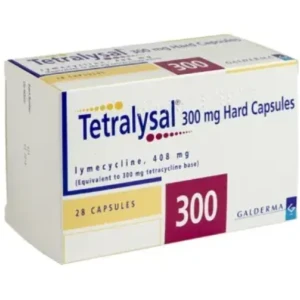
Tetralysal is a prescription-only antibiotic capsule used to treat acne. Its active ingredient is lymecycline, a tetracycline-class antibiotic that targets the bacteria responsible for acne breakouts. Unlike topical creams or gels that work on the skin's surface, Tetralysal works from inside the body to tackle the root cause of spots and inflammation.
The medication comes in one strength, Tetralysal 300, which contains 408 mg of lymecycline per capsule. It is typically used for moderate-to-severe acne, often alongside a suitable topical treatment as recommended by your prescriber.
Acne develops when a naturally occurring skin bacterium called Cutibacterium (Propionibacterium) acnes multiplies inside blocked pores, triggering inflammation and spot formation. Tetralysal works by directly targeting this bacterium.
Lymecycline is a bacteriostatic antibiotic, meaning it prevents bacteria from reproducing rather than killing them outright. It does this by binding to the 30S subunit of the bacterial ribosome. This is the structure bacteria use to produce the proteins they need to survive and grow. Without these proteins, bacteria cannot multiply, and the infection is controlled.
As bacterial activity reduces, skin inflammation settles, and spots have a chance to clear. Lymecycline may also have mild anti-inflammatory properties that help clear acne beyond its primary antibacterial effect. This includes calming redness and reducing inflamed spots over time. Its dual action makes Lymecycline an effective choice in managing moderate to severe acne.
Lymecycline (the active ingredient in Tetralysal) does not deal with the root cause of acne immediately. You should start to see improvement within 1 week, but it may take several weeks for acne to clear up significantly. After 8 weeks, see your doctor to review whether lymecycline has been effective for you. You should not take antibiotics such as lymecycline long-term without first seeking advice from your doctor.
Lymecycline has a robust clinical track record for treating acne. In a randomised controlled trial comparing lymecycline with minocycline (another tetracycline-class antibiotic), lymecycline was found to be at least as effective and generally well-tolerated. People taking lymecycline also had slightly fewer adverse gastrointestinal and skin effects. The trial was also double-blind and double-dummy, meaning neither participants nor assessors knew which medicine was which (as they looked the same), increasing reliability.
Studies consistently show a meaningful reduction in inflammatory lesions (the red, raised spots most commonly associated with moderate-to-severe acne) within 8 to 12 weeks of starting treatment. One example study showed that after 3 months of lymecycline treatment, the inflammatory count was reduced by 63% and the total lesion count by 58%. Lymecycline was also effective at reducing non-inflammatory lesions, such as blackheads and whiteheads, so it can be used for different acne types. As with all antibiotic treatments for acne, Tetralysal works best when combined with a consistent skincare routine and a suitable non-antibiotic topical treatment.
Real-world results vary from person to person, and it may take several weeks before you see improvement. As an antibiotic, it's important to complete the full prescribed course even if your skin begins to clear sooner.
Take 1 Tetralysal 300 capsule once daily at around the same time each day (preferably in the morning). Carefully tear the aluminium strip to remove the capsule. Swallow it whole with a full glass of water. You can take it with or without food, but you may be less likely to feel sick if you have it with food. Absorption of Tetralysal is not affected by moderate amounts of milk.
If you forget to take your regular dose of Tetralysal, there's no need to worry. Take it as soon as you remember, then return to your usual schedule. However, if it's almost time for your next dose, skip the missed one and just take the next one instead. Do not double-up on capsules to make up for a missed dose. Do not take more Tetralysal than your prescriber recommends.
If you take too many Tetralysal capsules, immediately contact your clinician or doctor for advice, or go to your nearest hospital. Take the medication container with you so staff can tell how much and what you have taken.
Acne typically responds slowly to antibiotics, so it may take some time before you start to notice visible results. It's essential that you take all of the Tetralysal that your clinician has prescribed, as stopping early could cause your acne or infection to come back or get worse. If you are unsure whether Tetralysal is right for you, speak to your doctor.
Just like any medication, Tetralysal may not be suitable for everyone. Review the following safety information to learn about the potential side effects of Tetralysal use and determine whether it is the right choice for you.
Not everyone who takes Tetralysal will experience side effects. However, if you experience unwanted side effects, discuss them with your doctor or pharmacist. Reported side effects of Tetralysal use include:
Common (may affect up to 1 in 10 people) | Frequency Unknown* |
|---|---|
|
*Further Frequency Unknown side effects are discussed in the following sections.
Please note that the above is not an exhaustive list of possible Tetralysal side effects. More information can be found within the Patient Information Leaflet that comes with the medication. You can also report any adverse reactions to the MHRA's Yellow Card Scheme.
Additional side effects have also been reported in people taking the same class of medicines to which Tetralysal belongs (tetracycline antibiotics). These include:
You should stop taking Tetralysal and seek immediate medical attention if you experience any of the following side effects:
The frequency of allergic (hypersensitivity) reactions is unknown. Symptoms include difficulty breathing, swelling of the face, lips, tongue, or throat, and rash or hives (a raised itchy rash). Seek emergency medical assistance if any of these symptoms occur.
Symptoms such as visual disturbance, headaches, vomiting, or permanent loss of vision may indicate increased pressure in the brain (intracranial hypertension). You should stop taking Tetralysal and seek medical attention if you experience symptoms of intracranial hypertension.
Tetralysal is available by prescription for people with moderate to severe acne. Your prescriber will review your acne type, severity and any previous treatments before deciding whether Tetralysal is right for you. At Prescription Doctor, Tetralysal is only available for adults aged 18 and over.
You should not take Tetralysal capsules if you:
Tetralysal may not be suitable for everyone. Tell your prescriber if you have impaired liver or kidney function, have systemic lupus erythematosus (SLE), or have Myasthenia Gravis. You should also be aware that an overdose may result in liver problems. Avoid direct exposure to sunlight or artificial light (such as sunbeds). If you do experience skin discomfort, stop taking Tetralysal and speak to your doctor.
Much like any other antibiotic, treatment can result in a secondary bacterial or fungal infection. With tetracycline antibiotics, there is a particular risk of resistant staphylococcal enterocolitis (inflammation of the small intestine and colon caused by bacteria resistant to some antibiotic treatments).
If you take Tetralysal for an extended period, your doctor should check your blood composition, liver function, and kidney function. When taking the medicine, swallow whole with adequate amounts of water to reduce the risk of irritation or ulceration to the oesophagus.
Tell your prescriber if you are taking or have recently taken any other prescribed medicines, over-the-counter drugs, supplements, or herbal remedies. The following may interact with Tetralysal in some way:
The following medications are not suitable to take alongside Tetralysal:
Do not take the following medicines at the same time as Tetralysal, as these could affect how well Tetralysal works. Wait at least 2 hours after taking Tetralysal before you take:
Do not take Tetralysal if you are pregnant, may be pregnant, or are breastfeeding. Tetralysal can cross the placental barrier (affecting a foetus) and can be found in breast milk. Medicines such as Tetralysal may affect the growth of developing teeth and lead to permanent discolouration. If there is a chance you may become pregnant or are planning to have a baby, speak to your doctor for advice before taking Tetralysal.
Acne can return after completing a course of Tetralysal, particularly if underlying triggers, such as hormonal changes or excess oil production, remain. Some people maintain clear skin after treatment, while others experience a return of spots. Your prescriber may suggest a topical maintenance treatment to help keep acne under control once you stop the antibiotic.
If acne does return, your clinician may decide to switch to a different approach, such as a combined contraceptive pill for women or a topical retinoid. You may also be prescribed a repeat course of Tetralysal if you experienced improvements during your first round of treatment.
Tetralysal is used to treat acne, and for many people, taking tetracycline helps clear inflammation and spots where skincare alone has failed. However, you may not notice an improvement straight away (it may take several weeks before you see meaningful results). Once you reach the end of your course of Tetralysal, you may find that acne worsens or returns. If you are unsure whether Tetralysal is right for you, speak to your doctor or pharmacist.
NICE recommends reviewing first-line acne treatment after 12 weeks. If your treatment includes an oral antibiotic and your acne has completely cleared, your clinician may stop the antibiotic while you continue the topical treatment. If your acne has improved but has not completely cleared, the oral antibiotic may be continued alongside topical treatment for up to a further 12 weeks. Treatment containing an antibiotic should only continue beyond 6 months in exceptional circumstances and should be reviewed every 3 months.
Weight gain is not a recognised side effect of Tetralysal and does not appear in the product's known side effect profile. It is not commonly reported in clinical practice either. If you notice unexplained changes in your weight while taking Tetralysal, it's worth speaking to your prescriber/GP to explore other potential causes.
Tetralysal does not reduce the effectiveness of hormonal contraceptives, including the combined pill or the progestogen-only mini pill. Earlier concerns that antibiotics could interfere with contraceptive reliability have not been supported by current clinical evidence, and UK guidance confirms no additional contraceptive precautions are needed when taking lymecycline alongside hormonal contraception. However, if you have severe, watery diarrhoea, or any diarrhoea that lasts for more than 24 hours, your contraceptive pills may not protect you from pregnancy. Your prescriber or pharmacist can offer further guidance.
Yeast infection around the genital area (thrush) is a recognised side effect of medicines belonging to the tetracycline class of antibiotics. Tetralysal can disrupt the natural balance of bacteria in your body, which occasionally allows yeast (typically Candida) to overgrow and cause a thrush infection. This can affect the mouth or genitals. Not everyone experiences this, but it is a known side effect of antibiotic use generally rather than lymecycline specifically.
Thrush is usually straightforward to treat, but the appropriate antifungal depends on where the infection occurs. Speak to a pharmacist or GP for advice, particularly if symptoms affect the mouth. Tell your doctor that you are taking Tetralysal to ensure they prescribe you an appropriate thrush treatment.
There is no direct interaction between lymecycline and alcohol. However, alcohol consumption appears to be a risk factor for the development of acne. Whilst studies are conflicting and the mechanism behind this relationship remains unclear, you may wish to assess the impact that abstaining from excessive drinking has on your skin health.
If you have any concerns about drinking alcohol during your course of treatment, your clinician can advise you based on your individual circumstances. You should avoid exceeding the maximum recommended intake of alcohol, which is 14 units a week.
You cannot buy Tetralysal over the counter in the UK. It is a prescription-only medication, meaning you can only purchase it from a registered pharmacy with a valid prescription from a suitably trained clinician. This helps ensure the drug is used safely and avoids unnecessary antibiotic use, which can lead to resistance and may make antibiotics less effective in the future.
Yes, you can buy Tetralysal capsules online from trusted pharmacies such as Prescription Doctor. Our hassle-free service enables you to start a consultation at any time from the comfort of your own home. We even dispatch all medicines in plain packaging for complete confidentiality.
We make it easy to obtain licensed medication safely and securely. Our experienced clinicians will review your medical information to determine whether Tetralysal is suitable for your circumstances, and, if approved, your order will be dispatched by our General Pharmaceutical Council-registered pharmacy. Orders approved before 3pm on a weekday are also eligible for next-day delivery.
Keep Tetralysal out of sight and reach of children. Do not use after the expiry date printed on the carton. Do not store above 25°C and keep it in its original container. Always dispose of medications responsibly, asking your pharmacist for advice.
© 2013 - 2026 Al Muhsineen Limited. All Rights Reserved. Registered Pharmacy: 34 Halliwell Road, Bolton BL1 8RL. Registered Office: 254 First Floor, Shearbrow, Blackburn, England, BB1 8DS
Don't have an account?
Your account will be automatically created after placing your first order.