All inclusive service
No hidden fees

Your privacy is important, Prescription Doctor are committed to keeping your details completely confidential.
This is why we also take steps to conceal your prescription products under two layers of packaging.
We have a commitment to delivering a discreet service and understand your need for privacy. We ship all orders via a trackable courier using discreet, plain packaging.
Once your order is dispatched you will receive a tracking number via sms and email.
We deliver medications between Monday and Saturday. You can upgrade to Saturday delivery on Friday.
You should receive a tracking number with your order which you can use this number to track your parcel online. This should give you a clear indication of where your parcel is. If you haven’t received your parcel in the time frame given by our couriers, contact your local depot to find out where it is. You can also contact our support team who will do this for you.
On checkout you will be asked to leave your mobile number so our courier can text you about the delivery. This is also useful if the courier has problems finding your address. We will not use your mobile number for anything else.
You can pay for your order using credit, debit card or via bank transfer.
If you don’t have a credit or debit card you can pay via bank transfer. We will give you a unique reference number at checkout along with details of how to make the transfer. Once the money has cleared in our account, we will process your order.
We are a completely secure site and take many measures to ensure your details are kept safe. We understand that you have a right to extreme privacy when purchasing sensitive health medications. All information that you provide to us is stored on our secure servers. Any payment transactions will be encrypted using SSL technology.
You can pay for your order using credit, debit card and bank transfer.
Card Payment: Please notify us that you wish to cancel your order. Your refund will show available In 1 - 3 days.
Bank Transfer: A member of our team will contact you requesting for your bank details. These details are only used to transfer the funds back into your account.
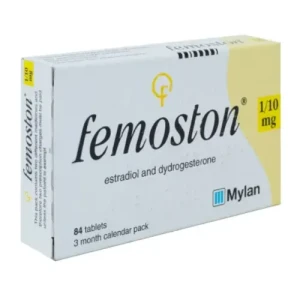
Femoston is a range of hormone replacement therapy (HRT) tablets used to treat oestrogen deficiency symptoms in postmenopausal women. Each medicine in the range contains two active ingredients: oestradiol, a form of the hormone oestrogen, and dydrogesterone, a synthetic progestogen. Both of these hormones work together to relieve menopausal symptoms while protecting the lining of the womb in women who still have their uterus. It is a prescription-only medicine (POM).
Femoston 1/10 contains 1mg oestradiol and 10mg dydrogesterone. It is typically the recommended starting dose, suited to women in the early postmenopausal period. Meanwhile, Femoston 2/10 contains 2 mg oestradiol and 10mg dydrogesterone. It may be prescribed when a higher oestrogen dose is needed to adequately control symptoms. Both Femoston 1/10 and 2/10 are cyclical (sequential) regimens in which the two hormones are taken in separate phases over a 28-day cycle, resulting in a predictable monthly withdrawal bleed for most women.
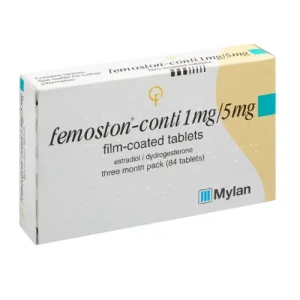
At Prescription Doctor, we also stock Femoston Conti, a continuous combined HRT that is available in two strengths.
Femoston contains two hormonally active ingredients that work together to address the bodily changes that occur during and after menopause.
As the ovaries produce less oestrogen during menopause, falling hormone levels drive many common symptoms. The most common ones are hot flushes, night sweats, vaginal dryness, sleep disturbance and mood changes. In Femoston, the exact oestradiol is synthetic 17β-oestradiol. This is both chemically and biologically identical to the oestradiol naturally produced by the ovaries. By boosting these falling levels, Femoston helps to relieve menopausal symptoms effectively. Oestrogen also plays a key role in maintaining bone density, and restoring oestrogen levels helps slow the faster rate of bone loss that follows menopause, reducing the risk of osteoporosis, a condition that weakens bones.
In women who still have a womb (uterus), taking oestrogen without a progestogen causes the womb lining (endometrium) to thicken over time, increasing the risk of endometrial (womb) cancer.
Dydrogesterone is an orally active synthetic progestogen that works much like natural progesterone. By opposing oestrogen's effect on the endometrium, it shifts the lining from the growing phase to the secretory phase, stabilising and protecting it throughout the treatment cycle.
In the cyclical regimens (Femoston 1/10 and 2/10), dydrogesterone is taken during the second phase of the cycle alongside oestradiol, triggering a withdrawal bleed at the end of each cycle for most women. This differs from Femoston Conti, in which both hormones are taken continuously, typically eliminating the monthly bleed.
The time it takes for HRT to take effect can vary from person to person. Many people begin to notice improved symptoms within a few weeks. For sequential forms of HRT ( such as Femoston 1/10 and Femoston 2/10), it can take up to 3 months to reach its full effect. This is broadly the same for all forms of oral HRT products.
Femoston has been studied extensively in clinical trials involving thousands of postmenopausal women, with robust evidence establishing its effectiveness for relieving oestrogen deficiency symptoms. NICE guidance recognises HRT as an effective treatment available for menopausal symptoms, and Femoston's oestradiol component addresses the hormonal deficiency driving them.
Symptom relief typically occurs within the first few weeks of treatment. A Cochrane systematic review (recognised as high-quality clinical research) of randomised, double-blind, placebo-controlled trials found that taking HRT reduced hot flush frequency by approximately 75% and significantly reduced its severity compared with placebo.
The Femoston summary of product characteristics (SmPC) confirms that, in clinical trials, menopausal symptom relief was achieved within the first few weeks in both sequential regimens (Femoston 1/10 and Femoston 2/10).
Responses will vary from person to person, and Femoston works best alongside lifestyle measures such as regular exercise, a balanced diet, and reduced alcohol intake. Femoston is also licensed for the prevention of osteoporosis in postmenopausal women at high risk who cannot tolerate other approved treatments.
Detailed instructions for taking Femoston are included in the Patient Information Leaflet that comes with the medication. Take one tablet a day without interruption between packs. Swallow whole with water. You can take Femoston with or without food. Your prescriber will aim to give you the lowest possible dose for the shortest time that adequately treats your symptoms.
Each 28-day strip/cycle contains 28 tablets, divided into two phases. For the first 14 days, take one white tablet daily for Femoston 1/10, or one red tablet daily for Femoston 2/10. For the following 14 days, take one grey tablet daily for Femoston 1/10 or one yellow tablet daily for Femoston 2/10. After completing the 28-day cycle, begin the next strip immediately without a break. A withdrawal bleed typically occurs during or shortly after the grey/yellow tablet phase and is expected with this regimen.
Femoston 1/10 is generally the recommended starting dose for most postmenopausal women. If symptoms (such as hot flushes, night sweats or vaginal dryness) are not adequately controlled after a trial period, your prescriber may increase this to Femoston 2/10 for a stronger oestrogen effect.
Use the lowest effective dose for the shortest necessary duration. Your prescriber should review whether continuing HRT is still appropriate for your circumstances at least once a year.
What to do if you forget to take Femoston tablets depends on how long it has been since you should have taken your dose. If it’s less than 12 hours, take a pill and then wait until your next scheduled dose. If more than 12 hours have passed, skip the missed dose and take the next one at your usual time. Do not try to double up and make up for a missed dose. Bleeding or spotting may occur if you miss a dose of HRT.
If you take too many Femoston tablets, you may experience symptoms such as nausea, vomiting, tender or painful breasts, dizziness, abdominal pain, drowsiness/tiredness, or withdrawal bleeding. However, you are unlikely to come to any harm. If you are at all worried, contact your clinician for advice.
Before using Femoston for the first time, you should review the following side effects and safety information. Carefully consider the risks vs benefits of using HRT. If you have any concerns about whether Femoston is suitable for you, contact one of our expert prescribers.
As with any medication, unwanted side effects from Femoston use can occur. Not everyone who uses Femoston will experience side effects. The table below includes a list of some of the reported side effects:
Very Common (in more than 1 in 10 patients) | Common (in less than 1 in 10, but more than 1 in 100 patients) | Uncommon (in less than 1 in 100 but more than 1 in 1,000 patients) |
|---|---|---|
|
|
|
Please note that the above is not an exhaustive list of possible Femoston side effects. Further side effects have been reported in all forms of HRT (including Femoston). More details can be found within the Patient Information Leaflet enclosed with the medication. You can also report any adverse reactions to your clinician or using the MHRA’s Yellow Card Scheme.
Serious side effects can occur. If you notice any of the following, stop taking Femoston immediately and contact your doctor:
Femoston includes a progestogen component that protects the womb from the extra risk of womb cancer associated with unopposed oestrogen. However, you should still remain vigilant for abnormal bleeding. See your doctor as soon as possible if you experience irregular or unexpected bleeding or spotting that carries on after the first 6 months of treatment, starts after you have been taking Femoston for 6 months, or carries on after you have stopped taking it. The use of HRT has also been associated with an increased risk of breast and ovarian cancer. The Patient Information Leaflet contains more information about the risk breakdown.
The risk of blood clots in a vein is 1.3 to 3 times higher in women who use HRT. This risk increases with age. Your prescriber will assess your medical history to determine whether you have any risk factors that would increase your risk of blood clots. Women over 60 who use oestrogen-progestogen HRT are slightly more likely to develop heart disease. The risk of stroke is also 1.5 times higher in HRT users, and this risk increases with age.
There is some evidence that there is a higher risk of memory loss in women who start using HRT after the age of 65.
Femoston is prescribed for postmenopausal women (at least six months since their last period) experiencing oestrogen deficiency symptoms. It is not suitable for women with:
If any of these conditions appear for the first time while taking Femoston, stop taking it and speak to your doctor immediately.
Before you are prescribed Femoston for the first time, your prescriber will assess your medical history. Certain conditions may recur or worsen during HRT. Tell your prescriber if you have any of the following:
You should also tell your clinician if you are due to have planned surgery, as you may need to stop taking it around 4-6 weeks before the operation to reduce the risk of a blood clot. Advise your surgeon that you have been taking the treatment as well. Your clinician will let you know when to restart the medication.
Some medicines may interfere with the effect of Femoston and may cause irregular bleeding. This includes medicines used to treat epilepsy, tuberculosis, and HIV, as well as herbal remedies including St John’s Wort.
Tell your prescriber if you are taking or have recently taken any prescribed medicines, herbal remedies, supplements, or over-the-counter treatments. The following medicines may interact with Femoston:
Your prescriber may advise you that Femoston is not suitable, or to seek advice from your general practitioner or specialist about your other medications.
Femoston is not a contraceptive and should only be used by post-menopausal women. However, if it has been less than 12 months since your last menstrual period or you are under the age of 50, you may still need to consider using contraception. Speak to your prescriber for advice. If you become pregnant while taking Femoston, stop using the medication and contact your doctor.
The key difference between Femoston 1/10 and Femoston 2/10 is the oestradiol dose. Both products follow the same 28-day cyclical regimen (14 days of oestradiol alone, followed by 14 days of oestradiol combined with 10mg dydrogesterone), but Femoston 1/10 contains 1mg of oestradiol per tablet, while Femoston 2/10 contains 2mg.
Femoston 1/10 is the recommended starting dose for most postmenopausal women. If symptoms are not adequately controlled, your prescriber may increase the dose to Femoston 2/10 for a stronger oestrogen effect. Both products contain 10 mg dydrogesterone during the second phase to provide endometrial protection.
The main difference between Femoston (1/10 or 2/10) and Femoston Conti lies in the type of HRT regimen they provide and how the hormones are administered.
Femoston 1/10 and Femoston 2/10 are cyclical regimens. The hormones are administered in two phases over a 28-day cycle: oestradiol alone for the first 14 days, followed by oestradiol combined with dydrogesterone for the next 14 days. This cycling causes a predictable monthly withdrawal bleed for most women.
Femoston Conti is a continuous combined regimen, meaning you take both oestradiol and dydrogesterone daily without breaks or hormonal cycling. Because there is no phase change, most women do not experience a monthly withdrawal bleed. Some irregular spotting may occur when first starting Femoston Conti, but this usually settles with time.
The term "bioidentical" or "body-identical" refers to hormones that are chemically identical to those the body produces naturally. For Femoston, the answer depends on which of its two active ingredients you are considering.
The oestradiol in Femoston is body-identical. It is synthetic 17β-oestradiol, chemically and biologically identical to the oestradiol produced by the human ovaries. This is the same regulated form of oestrogen used in many licensed HRT products available in the UK.
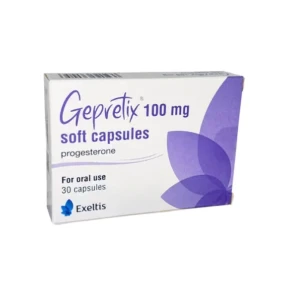
The dydrogesterone component is not bioidentical. It is a synthetic progestogen that, while similar in activity to natural progesterone, has a different chemical structure. This distinguishes Femoston from products such as Gepretix or Utrogestan, which contain micronised progesterone, a progestogen that is chemically identical to the progesterone naturally produced by the body. Femoston can therefore be described as containing a body-identical oestrogen paired with a synthetic progestogen.
Yes. Combined HRTs include both an oestrogen and progestogen component. Femoston 1/10 and 2/10 are considered sequential combined products (they include an oestrogen-only and an oestrogen-progestogen phase).
For women who still have a womb, it is unsafe to take oestrogen without a regular progestogen component due to the increased risk of endometrial hyperplasia and cancer. Other HRT products are available containing only oestrogen that should be taken alongside a separate progestogen medication.
Weight change is a recognised side effect of Femoston. In clinical trial data involving over 4,900 women, weight gain is listed as a ‘common’ side effect (affecting between 1 in 100 and 1 in 10 women), while weight loss is uncommon. However, context matters when interpreting this.
Many postmenopausal women experience changes in body composition and weight distribution as a direct result of the hormonal changes during the menopause itself, independently of HRT. This makes it difficult to separate the medicine's effects from the natural changes happening at this stage of life.
Some women also notice bloating or fluid retention in the early weeks of starting Femoston, which can feel like weight gain but often settles as the body adjusts to treatment. If you notice significant or persistent weight changes after starting Femoston, speak to your prescriber.
Hair loss is not listed as a recognised side effect of Femoston. Hair thinning and changes in hair texture are common experiences during and after the menopause. This is due to the natural decline in oestrogen and other hormonal changes at this stage of life.
Some women notice these changes coinciding with starting HRT, which can create the impression that the medicine is responsible. In many cases, the hair changes are part of the underlying hormonal transition rather than a direct effect of Femoston. If you experience significant or unexplained hair loss while taking Femoston, speak to your GP. Your doctor should investigate and rule out other causes.
No. Femoston is a prescription-only medication. This means that you will need to have your medical history reviewed by a trained prescriber to determine whether it is safe and suitable for you. Once you have a prescription, you can purchase Femoston from a licensed pharmacy. At Prescription Doctor, our expert prescribers will review your confidential online consultation to determine whether Femoston is right for you.
Yes, you can buy Femoston online from trusted pharmacies such as Prescription Doctor with no need for an appointment. With us, you can complete a short medical questionnaire anytime from the comfort of your home. It’s that straightforward.
Our team of specialist clinicians will review your information to confirm the medication is safe and suitable for you to use before passing your order to our General Pharmaceutical Council-registered pharmacy for dispatch. We dispense everything in plain packaging that does not disclose its contents, and orders approved before 3pm Monday to Friday are also eligible for next-day delivery.
Keep out of sight and reach of children. Do not use after the expiry date printed on the pack (the “use before” date refers to the last day of that month). Do not dispose of medicines down the drain or in the household waste. Your local pharmacist can help you to dispose of medication responsibly.
© 2013 - 2026 Al Muhsineen Limited. All Rights Reserved. Registered Pharmacy: 34 Halliwell Road, Bolton BL1 8RL. Registered Office: 254 First Floor, Shearbrow, Blackburn, England, BB1 8DS
Don't have an account?
Your account will be automatically created after placing your first order.