All inclusive service
No hidden fees


Prices from £26.99
Review More Prices
Your privacy is important, Prescription Doctor are committed to keeping your details completely confidential.
This is why we also take steps to conceal your prescription products under two layers of packaging.
We have a commitment to delivering a discreet service and understand your need for privacy. We ship all orders via a trackable courier using discreet, plain packaging.
Once your order is dispatched you will receive a tracking number via sms and email.
We deliver medications between Monday and Saturday. You can upgrade to Saturday delivery on Friday.
You should receive a tracking number with your order which you can use this number to track your parcel online. This should give you a clear indication of where your parcel is. If you haven’t received your parcel in the time frame given by our couriers, contact your local depot to find out where it is. You can also contact our support team who will do this for you.
On checkout you will be asked to leave your mobile number so our courier can text you about the delivery. This is also useful if the courier has problems finding your address. We will not use your mobile number for anything else.
You can pay for your order using credit, debit card or via bank transfer.
If you don’t have a credit or debit card you can pay via bank transfer. We will give you a unique reference number at checkout along with details of how to make the transfer. Once the money has cleared in our account, we will process your order.
We are a completely secure site and take many measures to ensure your details are kept safe. We understand that you have a right to extreme privacy when purchasing sensitive health medications. All information that you provide to us is stored on our secure servers. Any payment transactions will be encrypted using SSL technology.
You can pay for your order using credit, debit card and bank transfer.
Card Payment: Please notify us that you wish to cancel your order. Your refund will show available In 1 - 3 days.
Bank Transfer: A member of our team will contact you requesting for your bank details. These details are only used to transfer the funds back into your account.
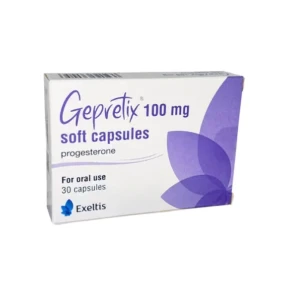
Gepretix is a prescription-only medicine containing micronised progesterone, a natural form of the female hormone progesterone. It is available as Gepretix 100 mg and Gepretix 200 mg soft capsules and is used as part of hormone replacement therapy (HRT) in post-menopausal women who still have a womb (intact uterus).
Gepretix is taken alongside an oestrogen medicine to protect the lining of the womb from the effects of oestrogen taken alone. It is not a contraceptive and is not suitable for use during pregnancy or breastfeeding.
Oestrogen is a central part of HRT and helps relieve common menopausal symptoms such as hot flushes, night sweats and vaginal dryness. However, in women who still have a womb, taking oestrogen without a progestogen causes the lining of the womb (the endometrium) to thicken excessively over time. This can increase the risk of endometrial (womb) cancer.
Gepretix works by counteracting this effect. As a natural progestogen, it acts on the endometrium, shifting it from the growing (proliferative) phase to the secretory phase and stabilising and protecting the womb lining.
As Gepretix contains micronised progesterone that is chemically identical to the progesterone your body produces naturally, many people prefer it to synthetic progestogens. It also has mild anti-oestrogenic, anti-androgenic and anti-aldosterone properties. These all contribute to its overall hormonal effects within your body.
Gepretix begins protecting the endometrium (womb lining) from the first cycle you take it alongside an oestrogen product as part of HRT. It’s important to remember that you won’t be taking Gepretix without an oestrogen component, and the menopausal symptom relief is primarily driven by the oestrogen medication. You may notice symptom improvement within a few weeks of starting HRT, but it may take up to 3 months to see its full effects.
Various clinical studies support Gepretix's effectiveness as part of combined HRT by examining protection of the endometrium (inner lining of the womb), breast tolerability, and cardiovascular safety.
A multicentre, randomised, double-blind, placebo-controlled trial in 875 post-menopausal women over three years discovered these key findings:
The trial design reduced the risk of bias, increasing the reliability of findings.
Meanwhile, a French prospective study in over 80,000 women found that HRT using natural progesterone was associated with a significantly lower risk of breast cancer compared to some synthetic progestogens, with a risk profile closer to that of non-HRT users. Finally, in a third case-control study, oral micronised progesterone was associated with a lower risk of venous thromboembolism (blood clots) compared with some synthetic progestogens.
Altogether, these studies support Gepretix as a well-evidenced component of combined HRT, with a hormonal profile that may offer advantages over some synthetic alternatives in terms of tolerability and safety.
Take your Gepretix capsule by mouth at bedtime, as directed by your prescriber. Your prescriber will prescribe the lowest possible dose to treat your symptoms effectively for as short a time as necessary. Take it on an empty stomach, as food increases the amount of medicine your body absorbs and may intensify side effects such as drowsiness or dizziness.
Swallow the capsule whole with a glass of water. Your prescriber will advise you on when in your monthly cycle to take Gepretix, as this depends on the type of oestrogen HRT you are using. Take your oestrogen HRT at the same time as Gepretix. You should continue to take your oestrogen HRT every day, following your prescriber’s advice.
After you have completed the Gepretix-taking phase of your monthly cycle, you will usually have a few days of withdrawal bleeding. If you have a problem with this bleed, your prescriber may change the way you take Gepretix.
The usual dose is 200 mg taken once daily at bedtime for twelve consecutive days per cycle, typically from Day 15 to Day 26. Alternatively, your prescriber may recommend 100 mg taken daily from Day 1 to Day 25 of each cycle. This method can lead to less withdrawal bleeding. Your prescriber will determine the most appropriate dose and schedule for you.
If you forget to take Gepretix as normal, take it as soon as you remember. If it’s nearly time for your next dose, skip the missed one and take the next at the regular time. Do not try to take a double dose to make up for a forgotten one.
If you take more Gepretix than you should, speak to a clinician or go to a hospital. Remember to take the medicine pack (containing the Patient Information Leaflet) with you to the hospital. You may experience adverse reactions such as drowsiness, sleepiness, tiredness, or dizziness.
Before taking Gepretix, it’s important that you are aware of potential side effects and risks associated with treatment. Some risks are associated with HRT in general and are often driven by the oestrogen component. This information will cover the listed side effects of Gepretix, as well as other potential risks of HRT use.
Not everyone who takes Gepretix will experience side effects. The frequency of side effects is not reported in the patient information leaflet; however, certain effects have been noted in clinical trials and with prescribed use:
Reported Side Effects (frequency unknown) | Observed in Clinical Trials (frequency unknown) |
|---|---|
|
|
This is not an exhaustive list of potential side effects of Gepretix. More information, including a detailed breakdown of potentially serious risks of HRT use, is available in the Patient Information Leaflet that comes with the medication. If you do experience any adverse reactions to the treatment, you can also report them using the MHRA’s Yellow Card Scheme.
Further side effects have been reported by women who use HRT. These side effects may not occur as a direct result of Gepretix use, but you should still be aware of them before commencing HRT:
Information regarding serious risks associated with HRT is discussed in the section “Gepretix Warnings and Interactions”.
Gepretix is prescribed for post-menopausal women who still have a womb and are taking oestrogen as part of HRT. It is not suitable for women who:
If any of these conditions appear for the first time whilst taking Gepretix, stop taking it and contact your doctor. You should undergo regular medical checkups whilst taking HRT.
You must tell your prescriber before taking Gepretix if any of the following apply to you, as they may return or become worse during treatment with HRT:
Your prescriber will assess the benefits and risks of taking HRT, ensuring you are informed about your options.
If you notice any of the following whilst taking Gepretix, stop taking it and seek immediate advice from your doctor:
HRT can provide significant relief for those struggling with the symptoms of the menopause. However, taking HRT can increase your risk of certain serious conditions. A full breakdown of the risk information is available in the Patient Information Leaflet contained within the medicine package.
Oestrogen HRT thickens the lining of the womb and can increase your risk of endometrial cancer. Gepretix is designed to protect you from this extra risk. You will have a monthly withdrawal bleed whilst taking Gepretix. If you experience bleeding or spotting besides your monthly bleeding which carries on after 6 months of taking Gepretix, starts after 6 months of taking it, or carries on after you have stopped taking it, see your doctor as soon as possible.
Taking HRT has also been linked to an increased risk of breast cancer. You should check your breasts regularly and see your doctor if you notice any changes. Taking HRT has also been associated with a slightly increased risk of ovarian cancer. Ovarian cancer is much rarer than breast cancer.
The risk of blood clots in the veins is 1.3 to 3 times higher in women who take HRT (especially during the first year of taking it). The patient information leaflet lists risk factors and symptoms of a blood clot that you should be aware of. Women over 60 who use oestrogen-progestogen HRT are slightly more likely to develop heart disease. HRT users also have about a 1.5 times higher risk of stroke. There is evidence of a higher risk of memory loss in women who start HRT after the age of 65.
Overall, you should speak to your doctor about the benefits and risks of HRT. They will help you to assess your individual risk factors and suitability for HRT. If you notice any signs of a serious condition whilst taking HRT, you should see your doctor immediately.
Tell your prescriber if you are currently taking or have recently taken any other prescribed medicines, over-the-counter medications, herbal remedies, or supplements. Gepretix can affect the way some medicines work and other medicines may interfere with the effect of Gepretix:
Gepretix is for use by post-menopausal women only. Do not take Gepretix if you are pregnant or may become pregnant. If you do become pregnant, stop taking Gepretix and contact your doctor immediately. You must talk to your doctor before taking this medicine if you are breastfeeding.
Gepretix and Utrogestan both contain micronised progesterone and are used in the same way as part of HRT to protect the womb lining in post-menopausal women. Although the active medication is the same, the capsules contain different ingredients (be aware of this if you have certain product allergies).
Utrogestan has been available in the UK for longer, while Gepretix is a newer alternative. Your prescriber may switch between them based on availability. Utrogestan is only available in 100 mg oral capsules.
Gepretix contains micronised progesterone, which is chemically identical to the progesterone your body produces naturally. For this reason, it is sometimes described as a "body-identical" hormone. This helps distinguish it from synthetic progestogens such as norethisterone or medroxyprogesterone acetate, which have different chemical structures and behave differently in the body.
Weight gain is not a commonly reported side effect of Gepretix. The PEPI trial, which studied 875 post-menopausal women over three years, did not identify weight gain as a significant finding in those taking micronised progesterone alongside oestrogen. It is also not listed as a potential side effect of the treatment in the Patient Information Leaflet.
Some women on HRT may experience fluid retention or bloating, particularly in the early weeks of treatment, but this is more commonly associated with oestrogen than with progesterone. If you notice changes in your weight during treatment, speak to your prescriber. They can help identify whether there is a hormonal cause and discuss adjustments to your regimen.
Gepretix is taken at bedtime because micronised progesterone can cause drowsiness and dizziness within 1 to 3 hours after taking a dose. This is a recognised effect of natural progesterone on the central nervous system. Taking Gepretix at night means any sedative effects occur while you are sleeping rather than during the day.
You should avoid driving or operating machinery after taking it. If you experience residual drowsiness the following morning, speak to your prescriber, as a dose adjustment may help.
No. Gepretix is licensed as an oral medication, meaning you take the capsule by mouth. Whilst there are some references online to taking progesterone vaginally, this is not licensed for HRT. Some prescribers may suggest using micronised progesterone off-label (in a way not generally approved but with evidence to support its use).
However, high-quality studies are still lacking to support vaginal use. Vaginal forms of progesterone (gels and capsules) are available but are used to treat other conditions, such as as part of fertility treatment (IVF).
There is no known significant interaction between alcohol and Gepretix. Equally, there is no major interaction between alcohol and the oestrogen component of HRT. This means you can drink in moderation whilst taking HRT. However, be aware that alcohol use may worsen some menopause symptoms (such as hot flushes) and can contribute towards the risk of some serious conditions when used in excess. The government recommends consuming no more than 14 units of alcohol a week.
No. Gepretix is only available with a prescription from an appropriately trained prescriber. This applies to all systemic HRTs. These medicines are prescription-only to ensure safe use and that they are taken by individuals for whom the benefits outweigh the risks. Some low-dose oestrogen products that are used vaginally are available over the counter to treat vaginal dryness.
Yes, you can buy Gepretix online from trusted pharmacies such as Prescription Doctor. There’s no need for an appointment or face-to-face consultation, just a straightforward form that our experienced clinicians can review to determine if the treatment is right for you.
All our licensed medications are dispatched from our General Pharmaceutical Council-registered pharmacy to your designated UK address in plain packaging for complete discretion. Orders approved before 3pm on a weekday are also eligible for next-day delivery.
Keep Gepretix capsules out of sight and reach of children. Do not store above 30°C and do not use after the expiry date printed on the carton. Do not dispose via household waste or wastewater. Ask your local pharmacist for advice on disposing of medications.
© 2013 - 2026 Al Muhsineen Limited. All Rights Reserved. Registered Pharmacy: 34 Halliwell Road, Bolton BL1 8RL. Registered Office: 254 First Floor, Shearbrow, Blackburn, England, BB1 8DS
Don't have an account?
Your account will be automatically created after placing your first order.