All inclusive service
No hidden fees

Prices from £24.99
Review More Prices
Your privacy is important, Prescription Doctor are committed to keeping your details completely confidential.
This is why we also take steps to conceal your prescription products under two layers of packaging.
We have a commitment to delivering a discreet service and understand your need for privacy. We ship all orders via a trackable courier using discreet, plain packaging.
Once your order is dispatched you will receive a tracking number via sms and email.
We deliver medications between Monday and Saturday. You can upgrade to Saturday delivery on Friday.
You should receive a tracking number with your order which you can use this number to track your parcel online. This should give you a clear indication of where your parcel is. If you haven’t received your parcel in the time frame given by our couriers, contact your local depot to find out where it is. You can also contact our support team who will do this for you.
On checkout you will be asked to leave your mobile number so our courier can text you about the delivery. This is also useful if the courier has problems finding your address. We will not use your mobile number for anything else.
You can pay for your order using credit, debit card or via bank transfer.
If you don’t have a credit or debit card you can pay via bank transfer. We will give you a unique reference number at checkout along with details of how to make the transfer. Once the money has cleared in our account, we will process your order.
We are a completely secure site and take many measures to ensure your details are kept safe. We understand that you have a right to extreme privacy when purchasing sensitive health medications. All information that you provide to us is stored on our secure servers. Any payment transactions will be encrypted using SSL technology.
You can pay for your order using credit, debit card and bank transfer.
Card Payment: Please notify us that you wish to cancel your order. Your refund will show available In 1 - 3 days.
Bank Transfer: A member of our team will contact you requesting for your bank details. These details are only used to transfer the funds back into your account.
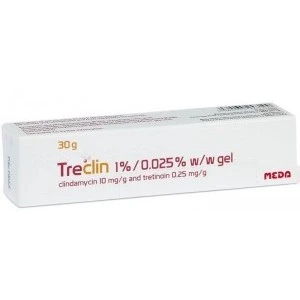
Treclin is used on the skin to treat acne vulgaris, specifically where comedones (blackheads and whiteheads), papules, and pustules are present. It's a translucent yellow gel supplied in 30g or 60g tubes.
Although it treats a condition that can look similar, Treclin is not a rosacea treatment. If you have rosacea, you must not use Treclin (see the warnings section below). If you're unsure whether your symptoms are acne or rosacea, your prescriber can help you determine which it is.
Acne develops when dead skin cells build up and block hair follicles, trapping sebum – the oil your skin naturally produces. Bacteria feed on this trapped oil and multiply, causing the redness and swelling of inflamed spots.
Treclin contains two active ingredients that tackle different parts of this process:
According to the Patient Information Leaflet, these two active substances are more effective for acne when combined than when used separately.
Treclin 1% gel typically takes several weeks (sometimes 12 weeks) to reach its optimal effect. It is not an overnight fix. It's important to keep using the treatment even when your skin starts to look better, as this is simply an indication that the medication has started working. Keep using it exactly as prescribed for the full course.
If your symptoms persist after 12 weeks, contact your prescriber for advice. They may need to reevaluate your treatment and could suggest an alternative approach.
The clindamycin and tretinoin combination has been tested extensively, and the evidence consistently shows that using both together beats using either one on its own. For example, two randomised controlled trials found that over 12 weeks, the clindamycin 1% and tretinoin 0.025% combination was significantly better than clindamycin alone, tretinoin alone, or a placebo gel at reducing inflamed spots, blackheads and whiteheads, and total spot counts. More people also ended up with clear or almost clear skin.
Another randomised double-blind trial discovered that significantly more people achieved a two-grade or greater improvement in their overall acne assessment with the combination gel than with either ingredient alone or a placebo.
Treclin gel's formulation also proved more effective than tretinoin alone for inflamed spots and than clindamycin alone for blackheads and whiteheads in European multicentre studies, with a faster response time being recorded with Treclin than either ingredient alone.
It's important to remember that everyone's skin responds differently, and results depend heavily on consistent use of Treclin. The medication works best when it's applied every night for the full course your prescriber recommends.
The recommended dose is a pea-sized amount, applied once daily at bedtime. Do not use more than your prescriber has advised or apply it more often. Using too much gel may irritate your skin, and it won't give you faster or better results.
Treclin shouldn't be applied at the same time as other preparations you put on your skin, including cosmetics. If you've been using products containing sulphur, salicylic acid, benzoyl peroxide, resorcinol, or any chemical abrasives, you'll need to wait until their effects have subsided before starting Treclin. Your prescriber will tell you when it's safe to begin treatment.
Applying Treclin properly makes a real difference to how well it works and how much irritation you get. Here's the routine:
Be careful when applying to sensitive areas of skin, and don't use Treclin with other topical products.
Treclin gel is not intended to be a long-term treatment for acne. You should use it for only 12 weeks and consult your doctor if symptoms have not improved by then, as your treatment plan may need to be reviewed.
To get the best results from Treclin acne gel, apply it exactly as prescribed and do not stop using it as soon as your acne starts to clear up. It may take several weeks to have an optimal effect.
Using more Treclin than recommended won't get you faster or better results. If you do apply too much, you may notice marked redness, peeling, or general discomfort.
If that happens, gently wash your face with mild soap and lukewarm water, and stop using Treclin until all symptoms have cleared. Then you can start again as prescribed.
If you forget to apply Treclin at bedtime, simply apply the next dose at the usual time. Don't double up to make up for the missed dose. Applying extra won't help and may irritate your skin.
Like all medicines, Treclin can cause side effects, although not everybody gets them. Most reported effects are skin reactions at the application site, and they're classed as uncommon rather than something most people should expect.
This section covers the side effects and what to do if you accidentally swallow the gel.
Here's a table of the potential side effects reported with Treclin gel use:
Uncommon (may affect up to 1 in 100 people) | Rare (may affect up to 1 in 1,000 people) |
|---|---|
|
|
If you'd like to know more about possible Treclin gel side effects, read the Patient Information Leaflet that comes with the medication. You can also report any adverse reactions to the treatment via the Yellow Card Scheme.
Treclin is only for use on the skin. If you accidentally swallow it, contact your doctor or go to your nearest hospital casualty department or A&E immediately.
Swallowing Treclin can cause side effects affecting your stomach and intestines, including stomach pain, nausea, vomiting, and diarrhoea. If this happens, stop using the gel and contact your doctor.
Like all medications, Treclin 1% gel may not be suitable for everyone. You should not use the treatment if:
If any of these apply to you, don't use Treclin. Instead, speak to your prescriber, who can suggest a suitable alternative.
There are a few important things to be aware of while using Treclin:
Treclin is unlikely to affect your ability to drive or operate machinery.
Tell your prescriber about any other medicines you're taking, have recently taken, or might take – including products bought without a prescription and herbal remedies. The following are particularly relevant:
Don't use Treclin if you're pregnant or planning a pregnancy. If you find out you're pregnant while using it, stop straight away and speak to your doctor.
The reason comes down to tretinoin, which belongs to a group of medicines called retinoids. When retinoids are taken by mouth, they're known to cause serious birth defects – affecting the way a baby's face, heart, and brain develop – and to increase the risk of miscarriage. That's why oral retinoids come with strict pregnancy prevention rules.
Treclin is applied to the skin rather than swallowed, so far less of the drug reaches your bloodstream, and that level of risk hasn't been shown with the gel. However, because the possibility can't be completely ruled out, the same precaution applies.
If you're a woman of childbearing age, that means using contraception throughout your course of treatment and for a further month after you stop – the extra month allows the medicine to clear from your system before a pregnancy could happen.
You also shouldn't use Treclin while breastfeeding, as it isn't known whether the ingredients pass into breast milk and could affect your baby. The Patient Information Leaflet doesn't give any specific information about Treclin and fertility – but if you're trying to conceive, or need acne treatment while breastfeeding, speak to your prescriber about alternatives that would suit you better.
Yes, if Treclin isn't right for you, there are several other acne treatments available through Prescription Doctor. Your prescriber can advise which suits your skin and the type of acne you have. Some of the medications we offer are:
For more information on the full range of treatments we offer, visit our Acne page.
Partly. Treclin contains tretinoin (0.025%) as one of its two active ingredients, alongside clindamycin (1%). It isn't a tretinoin-only product; the whole point of Treclin is that it combines a retinoid with an antibiotic in a single gel.
Treclin contains a retinoid, but it isn't purely a retinoid treatment. Tretinoin is the retinoid component, and clindamycin is a topical antibiotic. So Treclin is best described as a combination of an antibiotic and a retinoid gel.
It can, temporarily. Acne is listed as an uncommon side effect, affecting up to 1 in 100 people, and some people notice their skin looks worse in the early weeks as the tretinoin speeds up skin cell turnover and brings existing blockages to the surface. This usually settles. If your acne gets significantly worse or the irritation is severe, speak to your prescriber.
Treclin isn't used to treat existing acne scars. It can help prevent future scarring by clearing active acne – and avoiding picking or squeezing your spots makes a big difference, too. If acne scarring is a concern, speak to your GP or a dermatologist about treatment options.
Treclin isn't licensed to treat pigmentation, and it shouldn't be used for that purpose. Tretinoin promotes skin cell turnover, which may help post-inflammatory marks fade over time as your acne clears, but that's a side benefit rather than the treatment's primary purpose. It's worth knowing that loss of skin pigmentation is listed as a rare side effect.
Keep Treclin out of the sight and reach of children. Don't store it above 25°C and don't freeze it. Keep the tube tightly closed, and don't use it after the expiry date printed on the carton and tube. Once you've opened the tube, the gel has a shelf life of three months.
Presentation: Gel
Available Strength: 1% / 0.025% w/w gel
Exemption: Prescription-only medication
Application: Men and women over 18 with acne
Dosage: Apply a pea-sized amount to the affected area once a day at bedtime
Description: Combination gel containing an antibiotic (clindamycin) and a topical retinoid (tretinoin) to treat acne
Drug Class: Topical antibiotic and retinoid combination
Alcohol Consumption: No influence on the medicine. Take care with alcohol-based skincare products, which may dry the skin.
When Pregnant: Do not use if you are pregnant or intend to become pregnant
When Breastfeeding: Do not use if you are breastfeeding
Prices From: 24.99 GBP
© 2013 - 2026 Al Muhsineen Limited. All Rights Reserved. Registered Pharmacy: 34 Halliwell Road, Bolton BL1 8RL. Registered Office: 254 First Floor, Shearbrow, Blackburn, England, BB1 8DS
Don't have an account?
Your account will be automatically created after placing your first order.